

- Home
- Insights
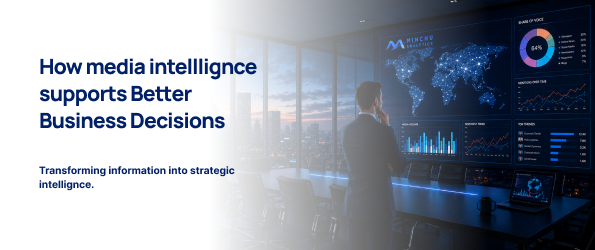
How Media Intelligence Supports Better Business Decisions
- 6 Min Read
- JUN 14, 2026
- Minchu Analytics Team
Transforming Information into Strategic Intelligence
Every day, organizations are surrounded by an unprecedented volume of information. News articles, digital publications, social conversations, analyst opinions, regulatory announcements, customer feedback, podcasts, executive interviews, and industry commentary continuously influence how businesses are perceived.
Yet information alone rarely creates competitive advantage.
Organizations that consistently make stronger strategic decisions are not those with the largest amount of data—they are the ones that understand what the information means, why conversations are evolving, who is shaping them, and how they may influence future business outcomes.
This is where Media Intelligence becomes indispensable.
Unlike traditional media monitoring, which focuses primarily on collecting mentions and coverage, Media Intelligence transforms fragmented information into meaningful business intelligence. It provides context, identifies emerging narratives, uncovers stakeholder expectations, and delivers insights that enable leaders to communicate with confidence.
At Minchu Analytics, we believe the true value of intelligence lies not in the quantity of information collected, but in the clarity it provides to decision-makers.
Information Is Everywhere. Intelligence Is Rare.
Modern organizations operate in one of the most information-rich environments in history.
A single corporate announcement can generate thousands of news articles, analyst reports, investor discussions, customer reactions, LinkedIn conversations, industry commentary, podcasts, videos, and social media posts within hours.
The challenge today is no longer finding information.
The challenge is understanding which information deserves leadership attention.
Decision-makers need answers to questions such as:
- Which conversations genuinely matter?
- Which issues require immediate action?
- Which trends are accelerating?
- Which stakeholders are driving perception?
- Which narratives could influence tomorrow's business decisions?
Without interpretation, organizations often respond to noise instead of strategic developments.
Media Intelligence separates meaningful signals from overwhelming information.
Why Better Decisions Begin with Better Understanding
Every major business decision is influenced by external perception.
Whether launching a new product, entering a new market, responding to a crisis, strengthening investor confidence, communicating with regulators, or protecting brand reputation, leadership teams need a clear understanding of the broader communication environment.
Media Intelligence enables organizations to:
- Understand stakeholder expectations
- Monitor emerging narratives
- Detect communication risks early
- Evaluate campaign effectiveness
- Protect organizational reputation
- Benchmark competitors
- Support executive decision-making
- Respond proactively rather than reactively
In today’s communication landscape, context has become a strategic advantage.
Why Traditional Monitoring Is No Longer Enough
For many organizations, media monitoring still means receiving daily reports listing articles, mentions, and headlines.
While useful, these reports rarely answer the questions leadership teams actually ask.
Information today is characterized by several growing challenges.
Information Overload
Thousands of daily mentions make it increasingly difficult to distinguish important developments from routine coverage.
Fragmented Conversations
Stakeholder discussions occur simultaneously across newspapers, online media, social platforms, podcasts, forums, newsletters, and industry communities.
Rapid Narrative Shifts
Public perception can change within hours. Organizations need early visibility into emerging conversations before they become major issues.
Diverse Stakeholder Expectations
Customers, investors, regulators, employees, journalists, and partners often interpret the same event in entirely different ways.
Lack of Strategic Context
Raw data explains what happened.
It rarely explains why it matters.
Six Ways Media Intelligence Improves Business Decisions
1. It Connects Information with Business Context
Collecting information has become relatively easy.
Understanding its significance requires expertise.
Media Intelligence interprets coverage by explaining:
- Why conversations are growing
- What events triggered them
- Which stakeholders are influencing perception
- How developments could affect business objectives
Executives require interpretation—not information overload.
2. It Reveals How Different Stakeholders Think
Every announcement creates multiple conversations.
A product launch may be viewed differently by:
- Customers
- Investors
- Employees
- Journalists
- Regulators
- Industry analysts
- Competitors
Understanding these perspectives enables organizations to communicate more effectively and strengthen stakeholder relationships.
3. It Identifies Early Signals Before They Become Headlines
Major reputation issues rarely appear without warning.
They often begin as:
- Customer complaints
- Industry discussions
- Regulatory commentary
- Expert opinions
- Influencer conversations
- Emerging digital trends
Organizations that recognize these signals early gain valuable time to prepare and respond strategically.
4. It Strengthens Long-Term Reputation
Reputation is rarely shaped by one headline.
It develops through thousands of interactions across multiple channels over time.
Media Intelligence helps organizations understand:
- Which narratives build trust
- Which issues create concern
- Which messages resonate most
- How reputation evolves over months and years
Long-term reputation management begins with continuous understanding.
5. It Improves Competitive Positioning
Leading organizations benchmark more than financial performance
They benchmark communication performance.
Media Intelligence provides insight into:
- Share of Voice
- Executive visibility
- Brand positioning
- Industry influence
- Competitor messaging
- Emerging market opportunities
Understanding how competitors communicate often reveals opportunities to differentiate.
6. It Delivers Executive-Ready Intelligence
Senior leadership rarely has time to review hundreds of news articles.
They need concise intelligence that answers
- What happened?
- Why does it matter?
- Who is affected?
- What risks exist?
- What opportunities are emerging?
- What actions should leadership consider?
This transformation—from information to executive intelligence—is where Media Intelligence delivers its greatest value.
Media Intelligence in Practice
Product Launch
A global technology company introduces a new SaaS platform.
Rather than measuring only media coverage, Media Intelligence identifies customer sentiment, analyst reactions, competitive responses, and emerging narratives surrounding the launch.
Leadership uses these insights to refine messaging and strengthen customer engagement.
Reputation Management
A healthcare organization notices growing conversations about patient experience.
Instead of waiting for mainstream media coverage, communication teams identify recurring concerns early and implement proactive engagement strategies.
Investor Communications
Before announcing quarterly earnings, a financial institution evaluates investor sentiment, analyst expectations, competitor positioning, and regulatory developments.
Leadership enters earnings discussions with greater confidence and strategic clarity.
Crisis Preparedness
A manufacturing company detects growing online discussions regarding supply chain disruptions.
Rather than reacting after widespread media attention, leadership communicates proactively, reducing uncertainty and reinforcing stakeholder trust.
How Minchu Analytics Helps
At Minchu Analytics, we combine experienced human analysts with technology-enabled methodologies to deliver intelligence that supports real business decisions.
Our capabilities include:
- Media Monitoring
- Media Intelligence
- Reputation Intelligence
- Executive Intelligence
- Competitive Intelligence
- PR Measurement
- Crisis & Issues Intelligence
- Narrative Analysis
- Share of Voice Analysis
- Executive-Ready Reporting
Every engagement is tailored around an organization’s communication priorities, stakeholder ecosystem, and strategic objectives.
Key Takeaways
Organizations collect information
Successful organizations interpret it.
Media Intelligence enables leadership teams to:
- Understand stakeholder perception
- Anticipate emerging trends
- Protect organizational reputation
- Strengthen executive communication
- Measure communication effectiveness
- Benchmark competitors
- Improve strategic decision-making
Industry Perspectives

The Future of Media Intelligence: Where Human Expertise Meets Technology
Aug 10, 2026 •
6 min read
›

Building Executive-Ready Intelligence Reports
Aug 3, 2026 •
7 min read
›

Human Expertise in an AI-Driven Media Landscape
Jul 23, 2026 •
7 min read
›
Five Reputation Risks Every Organization Should Monitor
Jul 7, 2026 •
5 min read
›

Measuring Communication Success Beyond Media Coverage
Jun 20, 2026 •
6 min read
›
Protect Your Reputation Through Meaningful Intelligence
Every conversation influences perception.
Every perception influences decisions.
Whether you’re monitoring stakeholder trust, strengthening executive credibility, identifying emerging risks, or preparing for future communication challenges, Minchu Analytics helps transform reputation signals into meaningful intelligence that supports confident business decisions.
Measure Communication That Drives Business Outcomes
Communication is no longer judged by how much attention it receives—it is judged by the confidence it builds, the trust it strengthens, and the decisions it supports.
Whether you’re evaluating campaigns, strengthening executive visibility, measuring reputation, or demonstrating communication ROI, Minchu Analytics helps transform communication performance into meaningful intelligence that enables better business decisions.