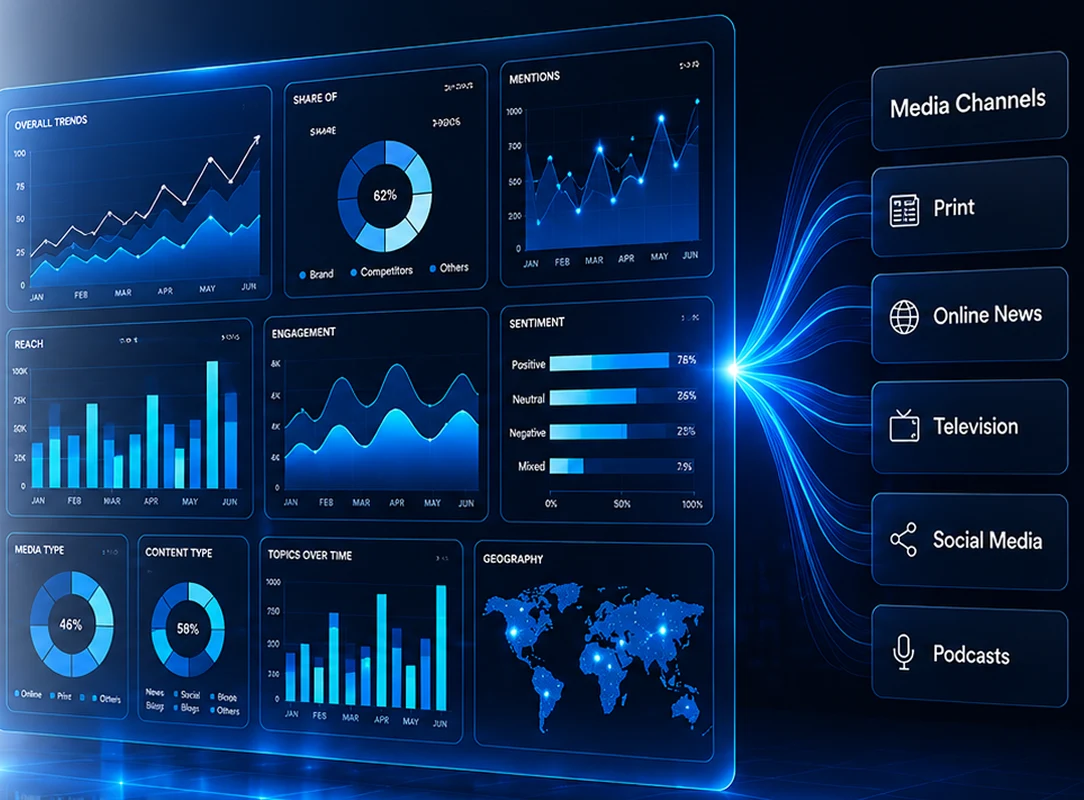
The Future of Media Intelligence: Where Human Expertise Meets Technology

The Future of Media Intelligence: Where Human Expertise Meets Technology

Combining Human Judgment with Intelligent Technology for Better Business Decisions.

Organizations today generate and consume more information than ever before. News travels globally within seconds. Social conversations influence public opinion in real time. Artificial intelligence can process millions of data points, while digital platforms continuously reshape how stakeholders engage with brands, institutions, and leaders.
As communication environments become increasingly complex, organizations require more than faster monitoring—they require better understanding.
The future of Media Intelligence will not be defined by technology alone.
It will be defined by the ability to combine technological efficiency with human expertise, strategic thinking, and contextual interpretation.
Artificial intelligence can rapidly identify patterns, detect anomalies, categorize information, and surface emerging conversations. However, understanding why those conversations matter, how stakeholders interpret them, and what actions organizations should take still requires experienced human judgement.
At Minchu Analytics, we believe the future belongs to organizations that combine the speed of technology with the insight of experienced analysts to transform information into meaningful intelligence.

Topic Introduction

Technology Is Changing Media Intelligence—But Not Replacing Human Expertise

Over the past decade, communication intelligence has evolved significantly.
Organizations have moved from manually collecting newspaper clippings to monitoring millions of conversations across news media, television, social media, podcasts, blogs, regulatory sources, financial publications, and industry forums.
Artificial intelligence has accelerated this evolution.
Modern platforms can now:

Monitor global conversations in real time.

Detect unusual spikes in discussion.

Categorize large volumes of content.

Recognize entities and topics.

Monitor global conversations in real time.

Detect unusual spikes in discussion.

Categorize large volumes of content.

Recognize entities and topics.

Identify sentiment patterns.

Generate automated summaries.

Discover emerging trends.

Identify sentiment patterns.

Generate automated summaries.

Discover emerging trends.

These capabilities have dramatically improved efficiency.
Yet leadership teams rarely ask:
“How many articles were collected?”

What does this mean?

Why is this happening?

What should we do next?

Technology provides information.
Human expertise provides understanding.
The future of Media Intelligence requires both.

Why It Matters

Better Intelligence Requires More Than Better Technology

Organizations today operate within increasingly uncertain business environments.
Stakeholder expectations change continuously.
Regulatory landscapes become more complex.
Competitive pressures intensify.
Digital conversations never stop.
Leadership therefore requires intelligence that is:
Executive-ready reporting enables organizations to:
Technology accelerates information processing.
Human expertise transforms information into confident decision-making.
Organizations that combine both capabilities gain significant competitive advantages.
Media Intelligence supports:

Industry Challenges

Why Technology Alone Cannot Solve Communication Complexity

Many organizations believe implementing advanced AI automatically improves communication intelligence.
In practice, several challenges remain.
Information Without Context
AI can identify keywords.
It cannot always understand organizational priorities, stakeholder sensitivities, political environments, or industry-specific nuances.
Sentiment Is Often More Complex Than Positive or Negative Sentiment Is Often More Complex Than Positive or Negative
• Irony
• Humour
• Mixed emotions
• Sarcasm
• Regulatory language
• Cultural context
Human analysts interpret these subtleties far more accurately.
Every Industry Speaks Differently • Financial institutions.
• Healthcare providers.
•Governments.
• Technology companies.
• Manufacturers.
• Each industry communicates differently.
•Human expertise recognizes these differences.
False Signals Can Create Unnecessary Concern Large data spikes do not always represent meaningful business issues.
Experienced analysts distinguish between:
• Temporary attention
• Genuine reputation risk
• Media cycles companies.
• Emerging long-term trends
Leadership Requires Recommendations Technology can explain what changed.
Leadership also needs guidance regarding:
• Implications
• Risks
•Opportunities
• Communication priorities

KEY INSIGHTS

1. Technology Makes Monitoring Faster

Modern monitoring technologies continuously capture conversations across:
Automation dramatically improves coverage and speed.

2. Human Analysts Create Business Context

Information becomes intelligence only after interpretation.
Experienced analysts explain:
Context transforms data into decisions.

3. AI Detects Patterns. Humans Understand Meaning.

Artificial intelligence excels at recognizing:
Together they create meaningful intelligence.

4. Executive Decisions Require Judgment

Executives rarely need every data point.
They require:
Human expertise converts complex datasets into executive-ready intelligence.

5. Stakeholder Behaviour Cannot Be Fully Automated

Every stakeholder interprets communication differently.

6. Trust Depends on Human Accountability

Leadership teams require confidence in intelligence.
Human analysts validate:

Human Expertise + Technology in Action

Crisis Detection

AI identifies an unusual increase in online conversations regarding product quality.
Human analysts determine:

• the issue originated from one regional incident
• influential journalists have not yet amplified it
• regulators are monitoring the discussion
• proactive communication should begin immediately

Leadership responds before reputation damage expands.

Executive Reputation

Technology tracks executive mentions globally.
Human analysts identify that several respected industry analysts increasingly describe leadership as innovation-focused.
Communications teams reinforce this positioning through future interviews and thought leadership.

Regulatory Intelligence

AI detects multiple regulatory announcements.
Experienced analysts explain:

• which policy changes matter
• likely stakeholder reactions
• competitor responses
• communication implications

Organizations prioritize resources effectively.

Competitive Intelligence

Technology measures Share of Voice.
Human analysts explain:

• why competitors are gaining attention
• which messages resonate
• where differentiation opportunities exist

Leadership gains strategic direction rather than numerical comparisons.

How Minchu Analytics Helps

Human Intelligence. Enhanced by Technology.

At Minchu Analytics, we believe technology should strengthen human expertise—not replace it.
Our intelligence framework combines advanced monitoring methodologies with experienced analysts who understand communication, reputation, stakeholder behaviour, and industry dynamics.
Our capabilities include:

Media Monitoring

Media Intelligence

Reputation Intelligence

Executive Intelligence

PR Measurement & Evaluation

Competitive Intelligence

Crisis & Issues Intelligence

Narrative Analysis

Share of Voice Analysis

Stakeholder Intelligence

Executive-Ready Reporting

Every engagement is tailored to your organization’s industry, communication objectives, stakeholder priorities, and strategic business goals.

Key Takeaways

The Future of Media Intelligence Is Collaborative

Organizations that rely solely on technology risk missing the context behind important conversations.
Organizations that rely only on manual analysis struggle to keep pace with today’s information environment.
Successful organizations will:
The future of Media Intelligence is not human or technology.
It is human expertise working alongside intelligent technology.

Industry Perspectives

Protect Your Reputation Through Meaningful Intelligence

Every conversation influences perception.
Every perception influences decisions.
Whether you’re monitoring stakeholder trust, strengthening executive credibility, identifying emerging risks, or preparing for future communication challenges, Minchu Analytics helps transform reputation signals into meaningful intelligence that supports confident business decisions.

Build the Future of Communication Intelligence with Confidence.

Technology continues to transform how organizations collect information, but meaningful business decisions still depend on human understanding.
Whether you’re monitoring reputation, strengthening executive communication, identifying emerging risks, measuring campaign performance, or supporting leadership with strategic insights, Minchu Analytics combines experienced human expertise with technology-enabled intelligence to help you make better decisions with greater confidence.

Building Executive-Ready Intelligence Reports

Building Executive - Ready Intelligence Reports

Delivering Intelligence That Leaders Can Act On.

Executives are expected to make important decisions every day—often with limited time and incomplete information. Whether responding to market developments, protecting organizational reputation, evaluating communication performance, or preparing for board discussions, leadership teams depend on clear, reliable intelligence rather than overwhelming volumes of data.
Yet many communication reports still focus on media coverage summaries, spreadsheets, dashboards, and hundreds of news articles without answering the questions executives actually need answered.
Leadership doesn’t need more information.
They need greater clarity.
At Minchu Analytics, we help organizations transform media monitoring into executive-ready intelligence that provides context, identifies strategic implications, highlights emerging opportunities, and supports confident business decisions.
An effective intelligence report doesn’t simply describe what happened—it explains why it matters and what leaders should consider next.

Topic Introduction

Executives Don't Read Reports. They Read Conclusions.

Modern organizations generate enormous amounts of communication data every day.

Media coverage.

Social conversations.

Industry reports.

Analyst commentary.

Media coverage.

Social conversations.

Industry reports.

Analyst commentary.

Customer feedback.

Executive interviews.

Regulatory announcements.

Competitor activity.

Customer feedback.

Executive interviews.

Regulatory announcements.

Competitor activity.

While communication teams may spend hours collecting this information, executive leadership rarely has the time to review hundreds of pages of detailed reports.
Instead, leadership asks questions such as:

What changed this week?

Why does this matter?

What risks require attention?

What opportunities should we pursue?

How are stakeholders responding?

What should leadership do next?

Executive-ready intelligence bridges the gap between operational reporting and strategic decision-making.
It transforms information into understanding.

Why It Matters

Better Reports Lead to Better Decisions

Leadership teams increasingly rely on communication intelligence when making strategic business decisions.
Whether evaluating corporate reputation, responding to regulatory developments, monitoring competitors, or assessing communication performance, executives require reports that are:
Executive-ready reporting enables organizations to:
Ultimately, intelligence reports should reduce uncertainty—not increase it.

Industry Challenges

Why Traditional Reports Often Fail Leadership Teams

Many organizations invest heavily in monitoring but struggle to communicate insights effectively.
Common reporting challenges include:
Information Overload Leadership teams often receive reports containing hundreds of media mentions, charts, and statistics with little explanation of what truly matters. More information rarely creates greater understanding.
Too Much Operational Detail Operational reports frequently focus on daily monitoring activities instead of strategic business implications. Executives need insights—not workflows.
Lack of Business Context Many reports explain what happened but fail to explain:
• Why it happened.
• Why stakeholders care.
• What business implications exist.
• What actions should be considered.
Without context, reports become difficult to use.
Multiple Data Sources Many reports explain what happened but fail to explain:
• Print media
• Television
• Online news
• Social media
• Podcasts
• Industry journals
• Regulatory publications
Investor commentaryBringing these together into one meaningful narrative remains a challenge.
Limited Strategic Recommendations Many reports stop after presenting data. Executive reports should conclude with informed recommendations that help leadership determine appropriate next steps.

KEY INSIGHTS

1. Executive Reports Should Answer Business Questions

Executives rarely ask:
“How many articles were published?”
Instead they ask:
Executive intelligence should answer these questions clearly.

2. Context Is More Valuable Than Volume

A report containing 500 media mentions may appear comprehensive.
However, if leadership cannot understand:
the report provides limited value.
Context transforms information into intelligence.

3. Reports Should Prioritize Strategic Significance

Not every media mention deserves executive attention.
Effective intelligence separates routine developments from strategically important events.
Priority areas may include:
Leaders should immediately recognize what deserves their attention.

4. Intelligence Must Reflect Stakeholder Perspectives

Organizations communicate with many audiences simultaneously.
Executive reports should explain how different stakeholders interpret important developments.
These may include:
Understanding these differing perspectives supports stronger communication.

5. Recommendations Create Real Value

The final section of every executive report should move beyond observation.
Instead of simply reporting:
An executive should understand the most important developments within the first page. Good reporting respects executive time.

6. Executive Reports Should Be Designed for Decision-Making

Senior leaders often review reports in only a few minutes.
Reports should therefore be:
Recommendations transform reporting into decision support.

Executive Intelligence in Action

Quarterly Board Meeting

A multinational manufacturing company prepares for its quarterly board review.
Instead of presenting hundreds of media articles, the intelligence report highlights:

• Reputation changes
• Competitor developments
• Regulatory updates
• Emerging risks
• Executive visibility
• Strategic recommendations

Executive reports should explain how different stakeholders interpret important developments.

Product Launch

A technology company launches an AI platform.
Rather than reporting media volume alone, executive reporting explains:

• Customer sentiment
• Industry analyst feedback
• Competitive responses
• Executive thought leadership
• Message consistency
• Long-term positioning

Leadership gains a complete understanding of market reception.

Crisis Management

A transportation company experiences operational disruption.
Executive intelligence summarizes:

• Public perception
• Media narratives
• Government response
• Customer sentiment
• Recovery progress
• Communication effectiveness

Executive intelligence summarizes:

Investor Relations

A financial institution prepares earnings announcements.
Executive reporting includes:

• Investor expectations
• Analyst commentary
• Regulatory developments
• Executive visibility
• Market sentiment
• Competitive benchmarking

Communication becomes proactive rather than reactive.

How Minchu Analytics Helps

Executive Intelligence Designed for Leadership

At Minchu Analytics, every reporting framework is designed with executive decision-making in mind.
Rather than delivering lengthy monitoring summaries, we develop intelligence reports that provide context, interpretation, and strategic recommendations. Our capabilities include:

Executive Intelligence Reporting

Media Intelligence

Reputation Intelligence

Competitive Intelligence

Executive Visibility Analysis

Share of Voice Reporting

Narrative Analysis

Stakeholder Intelligence

PR Measurement

Crisis & Issues Intelligence

Strategic Briefings

Board-Level Communication Reports

Every engagement is tailored to your organization’s communication objectives, leadership priorities, and stakeholder landscape.

Key Takeaways

Executive Reports Should Enable Better Leadership

The best intelligence reports do more than summarize information.
They enable better decisions. Organizations that invest in executive-ready reporting are better positioned to:
Technology delivers speed.
Executive intelligence is not measured by the number of pages in a report. It is measured by the confidence it gives leaders to act.

Industry Perspectives

Protect Your Reputation Through Meaningful Intelligence

Every conversation influences perception.
Every perception influences decisions.
Whether you’re monitoring stakeholder trust, strengthening executive credibility, identifying emerging risks, or preparing for future communication challenges, Minchu Analytics helps transform reputation signals into meaningful intelligence that supports confident business decisions.

Equip Leadership with Intelligence They Can Trust

Modern leadership requires more than information—it requires clarity, context, and confidence.
Whether you’re preparing board reports, strengthening executive communication, monitoring reputation, evaluating competitors, or identifying emerging issues, Minchu Analytics delivers executive-ready intelligence that transforms complex media conversations into actionable business insight.

Human Expertise in an AI-Driven Media Landscape

Human Expertise in an AI-Driven Media Landscape

Why Technology and Human Intelligence Deliver Better Decisions Together.

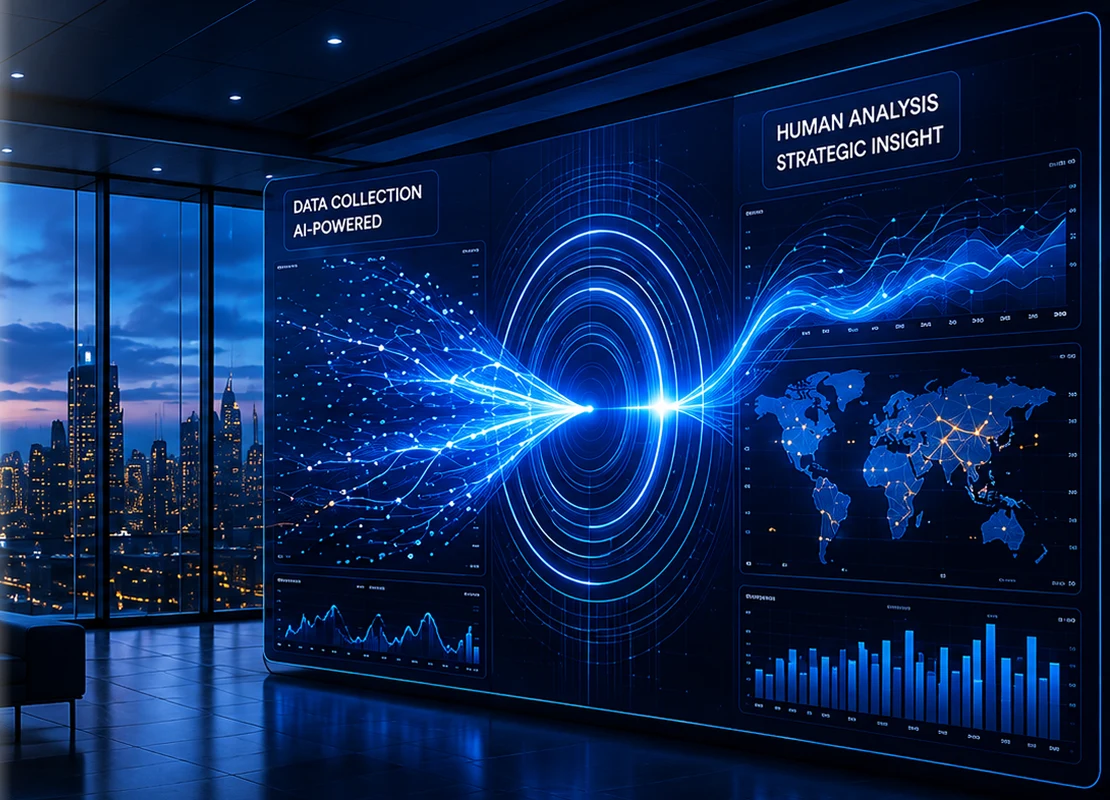
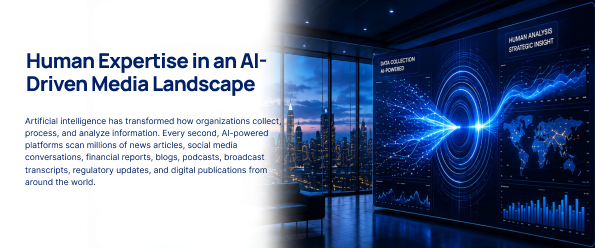
Artificial intelligence has transformed how organizations collect, process, and analyze information. Every second, AI-powered platforms scan millions of news articles, social media conversations, financial reports, blogs, podcasts, broadcast transcripts, regulatory updates, and digital publications from around the world.
This unprecedented capability has fundamentally changed how organizations monitor information. What once required days of manual effort can now be completed in minutes.
Yet despite these technological advances, one challenge remains unchanged.
Data alone cannot explain context.
Artificial intelligence can identify patterns, summarize conversations, and detect anomalies—but it cannot fully understand organizational priorities, stakeholder expectations, cultural nuance, strategic implications, or the human motivations that shape communication.
At Minchu Analytics, we believe the future of Media Intelligence is not a choice between humans and technology. It is the intelligent combination of both.
Technology accelerates information gathering.
Human expertise transforms information into strategic understanding.
That combination enables organizations to make better business decisions with greater confidence.
Title Introduction

Technology Collects Information. Humans Create Understanding.

Organizations today receive more information than at any point in history.
Every announcement, executive interview, earnings call, customer review, policy change, product launch, analyst report, and social media discussion contributes to an increasingly complex communication landscape.
Artificial intelligence has become exceptionally effective at helping organizations manage this volume.
It can rapidly:

Monitor thousands of news sources

Detect emerging topics

Classify content

Identify sentiment patterns

Monitor thousands of news sources

Detect emerging topics

Classify content

Identify sentiment patterns

Organize large datasets

Organize large datasets

Organize large datasets

Organize large datasets

Organize large datasets

Organize large datasets

These capabilities improve speed and efficiency.
However, leadership teams rarely make strategic decisions based solely on automated outputs.
They require interpretation.
Questions such as:

Why is this conversation growing?

Which stakeholders are driving it?

Is this trend meaningful or temporary?

How could this affect reputation?

Should leadership respond now?

What communication opportunities exist?

These questions require judgment, experience, and business context.
That is where human expertise remains essential.

Why It Matters

Better Decisions Require More Than Better Technology

Organizations increasingly invest in AI-powered communication tools to improve efficiency.
However, competitive advantage does not come from collecting more data.
It comes from understanding what the data means.
Combining AI with experienced analysts enables organizations to:
Technology improves speed.
Human expertise improves quality.
Together they create meaningful intelligence.

Industry Challenges

Why AI Alone Cannot Explain Every Conversation

Despite remarkable advances, AI still faces limitations when interpreting complex communication environments.
Context Is Often More Important Than Keywords The same headline can carry different implications depending on industry, geography, stakeholder group, and timing. Understanding context requires human interpretation.
Stakeholder Expectations Continue to Evolve Customers, investors, employees, regulators, media, and communities often respond differently to the same event. Technology can detect conversation volume. Experienced analysts explain why those differences matter.
Nuance Cannot Always Be Automated Sarcasm, cultural references, industry terminology, humor, irony, and subtle messaging often challenge automated systems. Human analysts provide the interpretation necessary for accurate intelligence.
Not Every Trend Deserves Executive Attention AI identifies numerous emerging conversations every day. Only a small percentage become strategically important. Human expertise helps separate meaningful developments from routine noise.
Business Priorities Differ Across Organizations The same news event may present a risk for one organization and an opportunity for another. Effective intelligence aligns external developments with organizational objectives.

KEY INSIGHTS

1. AI Accelerates Information Collection

Modern AI technologies can process millions of information sources simultaneously.
This dramatically improves:
Organizations benefit from broader visibility than ever before.

2. Human Intelligence Provides Context

Experienced analysts interpret information within its broader business environment.
They evaluate:
This transforms data into meaningful insight.

3. Judgment Cannot Be Fully Automated

Leadership decisions require balancing multiple perspectives.
Human expertise helps determine:
Judgment remains a uniquely human capability.

4. Reputation Requires Continuous Interpretation

Reputation develops gradually through thousands of interactions across multiple communication channels.
Understanding how trust evolves requires continuous observation, interpretation, and strategic analysis.
Human expertise identifies subtle changes before they become major reputation issues.

5. Executive Leaders Need Recommendations—Not Just Reports

Executives rarely need hundreds of pages of data.
They need concise answers to questions such as:
Human analysts bridge the gap between data and decisions.

6. The Future Is Human + Technology

The strongest Media Intelligence programs combine:
Organizations that combine both capabilities make faster and better-informed decisions.

Human Expertise in Action

Crisis Monitoring

An AI platform detects a sudden increase in online discussion regarding a manufacturing company.
Human analysts determine that the conversation originated from a localized operational issue rather than a widespread crisis, enabling leadership to respond proportionately and avoid unnecessary escalation.

Executive Reputation

Automated monitoring identifies increased mentions of a CEO following an industry conference.
Human analysts recognize that the conversation reflects growing thought leadership rather than controversy, allowing communications teams to amplify positive visibility.

Regulatory Intelligence

AI identifies multiple regulatory announcements across different markets.
Experienced analysts prioritize those most relevant to the organization’s operations, helping leadership focus on developments with the greatest strategic impact.

Competitive Intelligence

A competitor launches a new product and generates significant media attention.
Rather than simply measuring coverage volume, analysts evaluate stakeholder reactions, messaging effectiveness, and long-term market implications to inform strategic planning.

How Minchu Analytics Helps

Combining Technology with Human Expertise

Our approach combines advanced monitoring technologies with experienced analysts who understand industries, stakeholders, and communication strategy.
Our capabilities include:

Media Monitoring

Media Intelligence

Reputation Intelligence

Executive Intelligence

Competitive Intelligence

Crisis & Issues Intelligence

Narrative Analysis

Stakeholder Intelligence

Share of Voice Analysis

Executive-Ready Reporting

Every engagement is tailored to your organization’s communication objectives, industry landscape, and leadership priorities.

Key Takeaways

The Best Intelligence Is Built on Human Insight

Organizations that rely solely on automation risk missing the context behind important conversations.
Organizations that combine technology with experienced analysis are better equipped to:
Technology delivers speed.
Human expertise delivers understanding.
Together they create meaningful intelligence.

Industry Perspectives

Protect Your Reputation Through Meaningful Intelligence

Every conversation influences perception.
Every perception influences decisions.
Whether you’re monitoring stakeholder trust, strengthening executive credibility, identifying emerging risks, or preparing for future communication challenges, Minchu Analytics helps transform reputation signals into meaningful intelligence that supports confident business decisions.

Combine Technology with Human Expertise.

Artificial intelligence is transforming the way organizations monitor information, but meaningful intelligence requires more than algorithms alone.
Whether you’re strengthening reputation, supporting executive decision-making, identifying emerging risks, or evaluating stakeholder conversations, Minchu Analytics combines advanced technology with experienced human analysis to deliver the context, clarity, and confidence leaders need to make better business decisions.

Five Reputation Risks Every Organization Should Monitor

Five Reputation Risks Every Organization Should Monitor

Protecting Reputation Before Small Issues Become Major Crises.

An organization’s reputation is built over years but can change within moments.
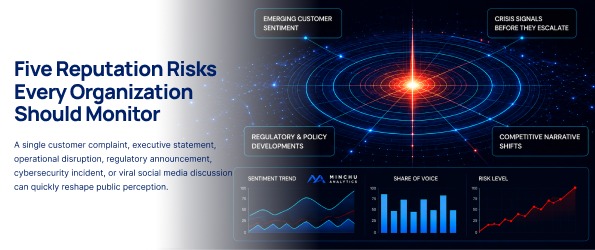
A single customer complaint, executive statement, operational disruption, regulatory announcement, cybersecurity incident, or viral social media discussion can quickly reshape public perception.
Today’s reputation is no longer influenced solely by traditional news coverage. It evolves continuously across digital media, social platforms, industry forums, investor discussions, employee communities, review websites, podcasts, and stakeholder conversations.
The challenge for modern organizations is not simply responding to reputation issues—it is identifying them early enough to act with confidence.
At Minchu Analytics, we help organizations move beyond reactive monitoring by providing meaningful intelligence that identifies emerging reputation risks, explains stakeholder perception, and enables informed communication before issues escalate.
Organizations that understand reputation early are better positioned to protect trust, strengthen stakeholder confidence, and support long-term business success.

Title Introduction

Reputation Is Constantly Evolving

Every organization has a reputation.
The real question is whether leadership understands how that reputation is changing.
Years ago, reputation evolved gradually through newspapers, television coverage, and corporate announcements.p understands how that reputation is changing.
Today, reputation develops every minute through thousands of conversations happening simultaneously across multiple channels.

Employees share experiences.

Journalists publish breaking news.

Industry experts offer opinions.

Influencers shape conversations.

Investors interpret market developments.

Employees share experiences.

Journalists publish breaking news.

Industry experts offer opinions.

Influencers shape conversations.

Investors interpret market developments.

Regulators announce policy updates.

Competitors influence industry narratives.

Most reputation challenges begin quietly.

Regulators announce policy updates.

Competitors influence industry narratives.

Most reputation challenges begin quietly.

Organizations that identify early signals gain valuable time to respond before conversations become headlines.

Why It Matters

Reputation Influences Every Business Decision

Reputation affects far more than public image.
It influences:
Strong reputations create resilience during periods of uncertainty.
Weak reputations amplify operational challenges.
Organizations that continuously monitor reputation are better prepared to communicate with confidence.

Industry Challenges

Why Reputation Has Become More Difficult to Manage

Modern organizations operate within one of the fastest-moving communication environments in history.
Common challenges include:
Always-On Conversations Stakeholder discussions continue around the clock across global media channels.
Information Spreads Instantly Small issues can become international conversations within hours.
Multiple Stakeholder Expectations Customers, investors, employees, regulators, partners, and journalists often interpret the same event differently.
Digital Permanence Online conversations remain searchable long after the original issue has passed.
Fragmented Media Landscape Traditional media represents only one part of today's communication environment.

KEY INSIGHTS

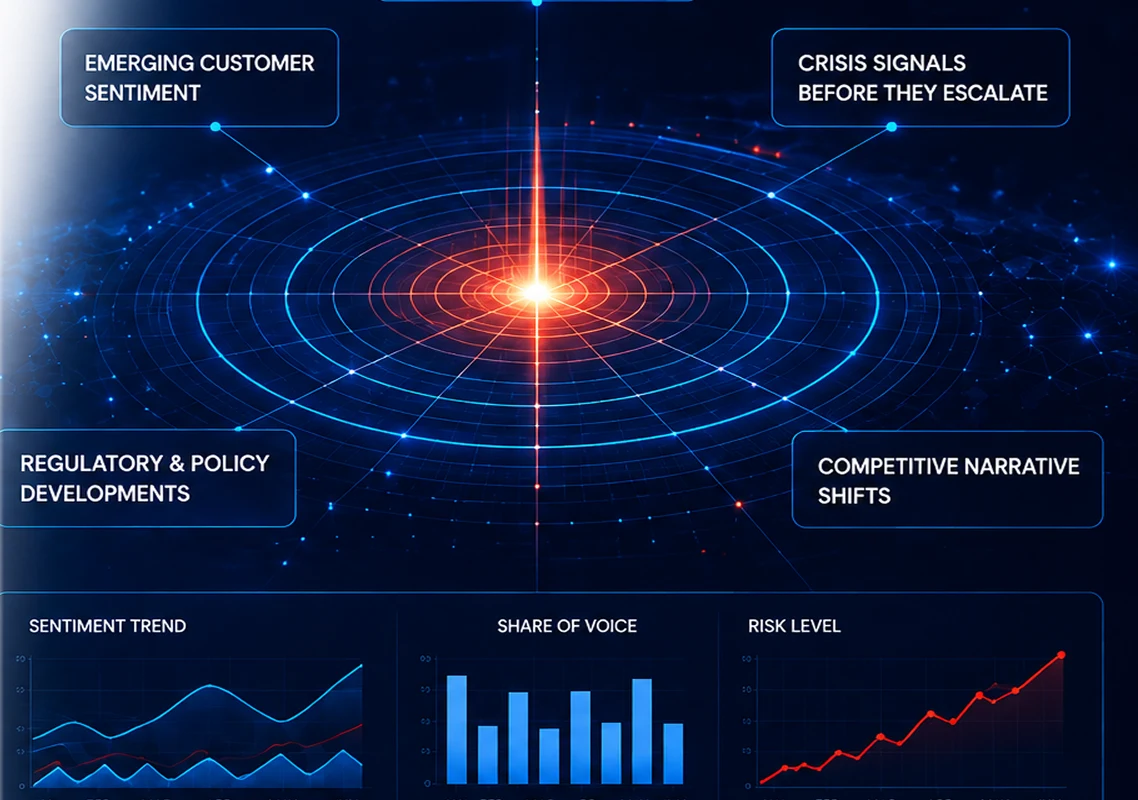
Emerging Customer Sentiment

Customer perception rarely changes overnight.
It develops gradually through:
Early changes in customer sentiment often indicate broader reputation shifts.
Organizations that monitor these conversations can improve communication before dissatisfaction becomes widespread.

Executive Reputation

Leadership visibility directly influences organizational credibility.
Executives increasingly represent their organizations through:
Strong executive communication strengthens trust.
Poor communication can rapidly influence stakeholder confidence.
Media Intelligence evaluates executive visibility alongside broader organizational reputation.

Regulatory & Policy Developments

Many reputation risks originate outside the organization.
Examples include:
Understanding these conversations early enables organizations to prepare proactive communication strategies.

Competitive Narrative Shifts

Competitors continuously influence industry perception.
Organizations should understand:
Competitive reputation intelligence helps organizations identify communication opportunities before competitors dominate industry narratives.

Crisis Signals Before They Escalate

Most crises begin as isolated conversations.
Examples include:
Organizations that identify these signals early gain valuable time to coordinate communication and reduce reputational impact.

Reputation Intelligence in Action

Healthcare Organization

Patient feedback begins highlighting longer waiting times.Media Intelligence detects increasing discussion across review platforms before traditional media coverage emerges.
Leadership introduces proactive communication and operational improvements.

Financial Institution

Growing online discussion questions digital banking reliability.

Rather than waiting for mainstream attention, leadership strengthens customer communication and improves service transparency.

Manufacturing Company

Local community discussions raise environmental concerns around a new facility.
Reputation Intelligence identifies the issue early, enabling stakeholder engagement before broader public attention develops.

Technology Company

Executive interviews begin generating inconsistent messaging around product strategy.
Leadership receives intelligence highlighting narrative differences, improving future communication consistency.

How Minchu Analytics Helps

Intelligence That Protects Reputation

Our Reputation Intelligence framework combines experienced human analysis with technology-enabled methodologies to identify meaningful reputation trends.
Our capabilities include:

Reputation Intelligence

Media Monitoring

Media Intelligence

Executive Intelligence

Crisis & Issues Intelligence

Stakeholder Sentiment Analysis

Narrative Analysis

Competitive Intelligence

Share of Voice Analysis

Executive-Ready Reporting

Every engagement is tailored to your organization’s communication objectives, stakeholder priorities, and industry landscape.

Key Takeaways

Reputation Is Built Before Headlines Appear

Organizations that protect reputation most effectively identify risks early.
Meaningful intelligence enables leaders to:
The earlier organizations understand changing narratives, the more options they have to respond strategically.

Industry Perspectives

Protect Your Reputation Through Meaningful Intelligence

Every conversation influences perception.
Every perception influences decisions.
Whether you’re monitoring stakeholder trust, strengthening executive credibility, identifying emerging risks, or preparing for future communication challenges, Minchu Analytics helps transform reputation signals into meaningful intelligence that supports confident business decisions.

Protect Your Reputation Through Meaningful Intelligence

Every conversation influences perception.
Every perception influences decisions.
Whether you’re monitoring stakeholder trust, strengthening executive credibility, identifying emerging risks, or preparing for future communication challenges, Minchu Analytics helps transform reputation signals into meaningful intelligence that supports confident business decisions.

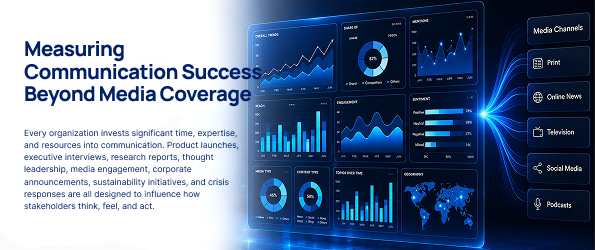
Measuring Communication Success Beyond Media Coverage

Measuring Communication Success Beyond Media Coverage

Understanding What Communication Actually Achieves.

Every organization invests significant time, expertise, and resources into communication. Product launches, executive interviews, research reports, thought leadership, media engagement, corporate announcements, sustainability initiatives, and crisis responses are all designed to influence how stakeholders think, feel, and act.
Yet many organizations continue to evaluate communication success using only one question:
“How much coverage did we receive?”
While media coverage remains an important indicator of visibility, visibility alone rarely reflects business impact.
A front-page article may generate limited influence if it reaches the wrong audience.
Meanwhile, a smaller publication may create significant value by shaping investor confidence, strengthening customer trust, influencing regulators, or positioning executives as industry thought leaders.
At Minchu Analytics, we believe communication should be measured not only by exposure—but by understanding its influence, relevance, credibility, and contribution to business objectives.
Meaningful PR measurement transforms communication activity into strategic business intelligence.

Title Introduction

Visibility Is Only the Beginning

For decades, organizations relied on media clippings, advertising value equivalency (AVE), and simple mention counts to evaluate communication performance.
Those metrics answered one question:
Did people see our message?
Today’s communication environment requires organizations to answer much more important questions.
Modern organizations require measurement frameworks that connect communication activities with organizational priorities.
Communication should no longer be measured by quantity.
It should be measured by impact.

Why It Matters

Better Measurement Creates Better Communication

Communication leaders increasingly contribute to strategic decision-making.
Executives expect communication teams to demonstrate measurable value—not simply produce activity reports.
Meaningful PR measurement helps organizations:
Organizations that measure communication intelligently continuously improve how they communicate.

Industry Challenges

Why Traditional PR Metrics Are No Longer Enough

Many communication reports still emphasize metrics that are easy to calculate but difficult to translate into business value.
Common challenges include:
Measuring Quantity Instead of Quality High coverage volumes do not necessarily indicate positive outcomes. Coverage quality often matters more than volume.
Focusing Only on Reach Large audiences do not always represent relevant stakeholders. Effective communication reaches decision-makers, customers, investors, regulators, and industry influencers—not simply larger audiences.
Lack of Business Context Communication reports frequently summarize media activity without explaining how communication supports organizational goals. Leadership requires insight—not activity summaries.
Fragmented Performance Data Campaign performance is often measured separately across media, social platforms, events, digital channels, executive communications, and stakeholder engagement. Organizations require one unified view.
Difficulty Demonstrating ROI Communication teams increasingly face pressure to demonstrate measurable contribution to organizational success. Traditional media reports rarely provide this perspective.

KEY INSIGHTS

1. Communication Should Be Measured Against Business Objectives

Successful communication begins with clear objectives.
Examples include:
Measurement should evaluate progress toward these objectives—not simply count media mentions.

2. Quality of Coverage Matters More Than Quantity

Not all media coverage creates equal value.
Organizations should evaluate:
One highly respected financial publication may create greater strategic value than dozens of low-impact mentions.

3. Share of Voice Provides Competitive Perspective

Communication performance should always be viewed relative to competitors.
Share of Voice helps organizations understand:
Benchmarking transforms isolated metrics into strategic insight.

4. Reputation Cannot Be Measured by Headlines Alone

Reputation develops over time through repeated stakeholder interactions.
Meaningful measurement evaluates:
Understanding reputation trends enables proactive communication.

5. Executive Visibility Influences Organizational Credibility

Leadership communication increasingly shapes organizational perception.
Measurement should evaluate:
Strong executive visibility strengthens trust across customers, investors, employees, and partners.

6. Campaign Success Extends Beyond Media Coverage

A successful communication campaign should answer questions such as

Media Intelligence in Practice

Product Launch Campaign

A technology company introduces a cloud platform.
Instead of reporting: “420 media mentions.” Meaningful measurement evaluates:
Leadership gains actionable insight rather than activity metrics.

Corporate Reputation Campaign

A financial institution launches a trust-building initiative.
These outcomes demonstrate strategic value beyond media exposure.

Corporate Reputation Campaign

A financial institution launches a trust-building initiative.
These outcomes demonstrate strategic value beyond media exposure.

ESG Communication

A manufacturing organization announces sustainability commitments.
Meaningful evaluation identifies:
The organization understands not only what was covered—but what influenced perception.

Crisis Recovery

Following an operational disruption, a telecommunications provider evaluates post-crisis communication.
Intelligence reveals:
This demonstrates communication effectiveness over time.

How Minchu Analytics Helps

Measuring What Truly Matters

At Minchu Analytics, our PR Measurement framework extends beyond traditional reporting.
We combine communication analytics with experienced human interpretation to help organizations understand both performance and business impact.
Our capabilities include:
Every reporting framework is tailored to your communication objectives, stakeholders, and industry priorities.

Key Takeaways

Measuring Communication That Matters

Effective communication measurement is about understanding influence—not simply counting visibility.
Organizations that adopt meaningful measurement are better positioned to:
Ultimately, organizations that measure communication intelligently communicate more effectively.

Industry Perspectives

Protect Your Reputation Through Meaningful Intelligence

Every conversation influences perception.
Every perception influences decisions.
Whether you’re monitoring stakeholder trust, strengthening executive credibility, identifying emerging risks, or preparing for future communication challenges, Minchu Analytics helps transform reputation signals into meaningful intelligence that supports confident business decisions.

Measure Communication That Drives Business Outcomes

Communication is no longer judged by how much attention it receives—it is judged by the confidence it builds, the trust it strengthens, and the decisions it supports.
Whether you’re evaluating campaigns, strengthening executive visibility, measuring reputation, or demonstrating communication ROI, Minchu Analytics helps transform communication performance into meaningful intelligence that enables better business decisions.

How Media Intelligence Supports Better Business Decisions

How Media Intelligence Supports Better Business Decisions

Transforming Information into Strategic Intelligence

Every day, organizations are surrounded by an unprecedented volume of information. News articles, digital publications, social conversations, analyst opinions, regulatory announcements, customer feedback, podcasts, executive interviews, and industry commentary continuously influence how businesses are perceived.
Yet information alone rarely creates competitive advantage.
Organizations that consistently make stronger strategic decisions are not those with the largest amount of data—they are the ones that understand what the information means, why conversations are evolving, who is shaping them, and how they may influence future business outcomes.
This is where Media Intelligence becomes indispensable.
Unlike traditional media monitoring, which focuses primarily on collecting mentions and coverage, Media Intelligence transforms fragmented information into meaningful business intelligence. It provides context, identifies emerging narratives, uncovers stakeholder expectations, and delivers insights that enable leaders to communicate with confidence.
At Minchu Analytics, we believe the true value of intelligence lies not in the quantity of information collected, but in the clarity it provides to decision-makers.

Information Is Everywhere. Intelligence Is Rare.

Modern organizations operate in one of the most information-rich environments in history.
A single corporate announcement can generate thousands of news articles, analyst reports, investor discussions, customer reactions, LinkedIn conversations, industry commentary, podcasts, videos, and social media posts within hours.
The challenge today is no longer finding information.
The challenge is understanding which information deserves leadership attention.
Decision-makers need answers to questions such as:
Without interpretation, organizations often respond to noise instead of strategic developments.
Media Intelligence separates meaningful signals from overwhelming information.

Why Better Decisions Begin with Better Understanding

Every major business decision is influenced by external perception.
Whether launching a new product, entering a new market, responding to a crisis, strengthening investor confidence, communicating with regulators, or protecting brand reputation, leadership teams need a clear understanding of the broader communication environment.
Media Intelligence enables organizations to:
In today’s communication landscape, context has become a strategic advantage.

Why Traditional Monitoring Is No Longer Enough

For many organizations, media monitoring still means receiving daily reports listing articles, mentions, and headlines.
While useful, these reports rarely answer the questions leadership teams actually ask.
Information today is characterized by several growing challenges.

Information Overload

Thousands of daily mentions make it increasingly difficult to distinguish important developments from routine coverage.

Fragmented Conversations

Stakeholder discussions occur simultaneously across newspapers, online media, social platforms, podcasts, forums, newsletters, and industry communities.

Rapid Narrative Shifts

Public perception can change within hours. Organizations need early visibility into emerging conversations before they become major issues.

Diverse Stakeholder Expectations

Customers, investors, regulators, employees, journalists, and partners often interpret the same event in entirely different ways.

Lack of Strategic Context

Raw data explains what happened.
It rarely explains why it matters.

Six Ways Media Intelligence Improves Business Decisions

1. It Connects Information with Business Context

Collecting information has become relatively easy.
Understanding its significance requires expertise.
Media Intelligence interprets coverage by explaining:
Executives require interpretation—not information overload.

2. It Reveals How Different Stakeholders Think

Every announcement creates multiple conversations.
A product launch may be viewed differently by:
Understanding these perspectives enables organizations to communicate more effectively and strengthen stakeholder relationships.

3. It Identifies Early Signals Before They Become Headlines

Major reputation issues rarely appear without warning.
They often begin as:
Organizations that recognize these signals early gain valuable time to prepare and respond strategically.

4. It Strengthens Long-Term Reputation

Reputation is rarely shaped by one headline.
It develops through thousands of interactions across multiple channels over time.
Media Intelligence helps organizations understand:
Long-term reputation management begins with continuous understanding.

5. It Improves Competitive Positioning

Leading organizations benchmark more than financial performance
They benchmark communication performance.
Media Intelligence provides insight into:
Understanding how competitors communicate often reveals opportunities to differentiate.

6. It Delivers Executive-Ready Intelligence

Senior leadership rarely has time to review hundreds of news articles.
They need concise intelligence that answers
This transformation—from information to executive intelligence—is where Media Intelligence delivers its greatest value.

Media Intelligence in Practice

Product Launch

A global technology company introduces a new SaaS platform.
Rather than measuring only media coverage, Media Intelligence identifies customer sentiment, analyst reactions, competitive responses, and emerging narratives surrounding the launch.
Leadership uses these insights to refine messaging and strengthen customer engagement.

Reputation Management

A healthcare organization notices growing conversations about patient experience.
Instead of waiting for mainstream media coverage, communication teams identify recurring concerns early and implement proactive engagement strategies.

Investor Communications

Before announcing quarterly earnings, a financial institution evaluates investor sentiment, analyst expectations, competitor positioning, and regulatory developments.
Leadership enters earnings discussions with greater confidence and strategic clarity.

Crisis Preparedness

A manufacturing company detects growing online discussions regarding supply chain disruptions.
Rather than reacting after widespread media attention, leadership communicates proactively, reducing uncertainty and reinforcing stakeholder trust.

How Minchu Analytics Helps

At Minchu Analytics, we combine experienced human analysts with technology-enabled methodologies to deliver intelligence that supports real business decisions.
Our capabilities include:
Every engagement is tailored around an organization’s communication priorities, stakeholder ecosystem, and strategic objectives.

Key Takeaways

Organizations collect information
Successful organizations interpret it.
Media Intelligence enables leadership teams to:

Industry Perspectives

Protect Your Reputation Through Meaningful Intelligence

Every conversation influences perception.
Every perception influences decisions.
Whether you’re monitoring stakeholder trust, strengthening executive credibility, identifying emerging risks, or preparing for future communication challenges, Minchu Analytics helps transform reputation signals into meaningful intelligence that supports confident business decisions.

Measure Communication That Drives Business Outcomes

Communication is no longer judged by how much attention it receives—it is judged by the confidence it builds, the trust it strengthens, and the decisions it supports.
Whether you’re evaluating campaigns, strengthening executive visibility, measuring reputation, or demonstrating communication ROI, Minchu Analytics helps transform communication performance into meaningful intelligence that enables better business decisions.

Understanding Media Narratives in an Era of Information Overload

Understanding Media Narratives in an Era of Information Overload

Information Is No Longer the Challenge. Understanding Is.

Never before have organizations had access to so much information. Every minute, news articles are published, opinions are shared across social platforms, television debates unfold, podcasts discuss emerging issues, and industry analysts offer new perspectives. For communication professionals, this constant stream of information presents both an opportunity and a significant challenge.
The challenge is no longer monitoring media coverage. The real challenge is identifying which conversations truly matter and understanding how they shape public perception.
A single news story can quickly evolve into multiple narratives across different platforms. A customer complaint may become a broader discussion about corporate responsibility. An industry announcement may influence investor confidence. A regulatory update may trigger public debate. Without context, organizations risk reacting to headlines rather than understanding the broader story.

What Is a Media Narrative?

A media narrative is more than a collection of news articles. It is the overarching story created by repeated themes, stakeholder opinions, media framing, and public conversations over time.
Narratives influence how organizations are perceived. They shape trust, affect reputation, influence customer confidence, and often determine how stakeholders interpret future communication.
Understanding these narratives requires more than automated monitoring. It requires experienced analysis capable of identifying recurring patterns, connecting seemingly unrelated events, and explaining why conversations are evolving.

Moving Beyond Headlines

Many organizations continue to measure media activity by counting mentions, estimating reach, or tracking keywords. While these metrics provide useful visibility, they rarely explain the strategic implications of communication.
Questions that matter include:
These questions transform monitoring into meaningful intelligence.

The Role of Human Expertise

Technology has significantly improved the speed of media monitoring. Artificial Intelligence can identify keywords, categorize articles, and detect trends across thousands of sources in real time.
However, understanding context remains a human capability.
Experienced analysts interpret tone, recognise cultural nuances, evaluate credibility, understand stakeholder behaviour, and explain the implications behind the data. This combination of technology and human judgment enables organizations to make informed decisions rather than reactive ones.

Looking Ahead

Organizations that succeed in today’s communication environment will not necessarily be those with the most information. They will be those with the greatest understanding.
Media narratives will continue to evolve rapidly, making meaningful intelligence more valuable than ever.
At Minchu Analytics, we believe that understanding the story behind the headlines is what enables confident decisions.

Industry Perspectives

Protect Your Reputation Through Meaningful Intelligence

Every conversation influences perception.
Every perception influences decisions.
Whether you’re monitoring stakeholder trust, strengthening executive credibility, identifying emerging risks, or preparing for future communication challenges, Minchu Analytics helps transform reputation signals into meaningful intelligence that supports confident business decisions.

Beyond Coverage: Measuring the Real Impact of Communications

Beyond Coverage: Measuring the Real Impact of Communications

Why Media Coverage Alone Is Not Enough

For many years, communication success was measured by the number of media mentions an organization received. More coverage often meant greater visibility, and visibility was assumed to represent success.
Today’s communication landscape demands a more meaningful approach.
Organizations are increasingly asking whether their communication efforts are influencing stakeholder perception, supporting business objectives, strengthening reputation, and contributing to long-term organizational goals.
These questions cannot be answered through coverage alone.

The Evolution of Communication Measurement

Modern communication measurement combines quantitative data with qualitative analysis.
It considers:
Together, these measures provide a more complete understanding of communication performance.

Measuring What Truly Matters

Meaningful communication measurement begins with clearly defined objectives.
Whether an organization seeks to build awareness, strengthen trust, influence policy, support product launches, or manage reputation, measurement should always reflect strategic outcomes rather than activity alone.
This requires analysing how communication contributes to organisational priorities rather than simply reporting media statistics.

From Reports to Strategic Insight

Traditional monitoring reports often describe events.
Strategic intelligence explains their significance.
Effective measurement identifies emerging trends, evaluates stakeholder reactions, highlights opportunities for improvement, and supports better communication planning.
Rather than asking “How much coverage did we receive?”, organizations should ask:

Looking Ahead

Communication is becoming increasingly measurable, but only when organizations focus on outcomes instead of outputs.
At Minchu Analytics, we believe communication measurement should provide clarity, demonstrate value, and support confident decision-making.

Industry Perspectives

Protect Your Reputation Through Meaningful Intelligence

Every conversation influences perception.
Every perception influences decisions.
Whether you’re monitoring stakeholder trust, strengthening executive credibility, identifying emerging risks, or preparing for future communication challenges, Minchu Analytics helps transform reputation signals into meaningful intelligence that supports confident business decisions.
+91 8550888815