

- Home
- Insights
The Future of Media Intelligence: Where Human Expertise Meets Technology
- 7 Min Read
- Aug 10, 2026
- Minchu Analytics Team
Combining Human Judgment with Intelligent Technology for Better Business Decisions.
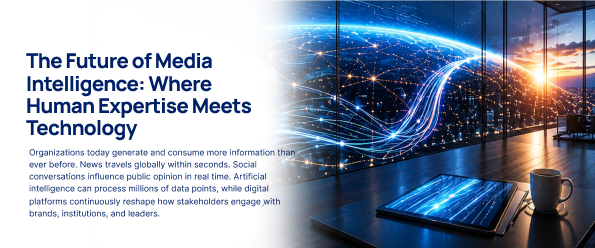
Organizations today generate and consume more information than ever before. News travels globally within seconds. Social conversations influence public opinion in real time. Artificial intelligence can process millions of data points, while digital platforms continuously reshape how stakeholders engage with brands, institutions, and leaders.
As communication environments become increasingly complex, organizations require more than faster monitoring—they require better understanding.
The future of Media Intelligence will not be defined by technology alone.
It will be defined by the ability to combine technological efficiency with human expertise, strategic thinking, and contextual interpretation.
Artificial intelligence can rapidly identify patterns, detect anomalies, categorize information, and surface emerging conversations. However, understanding why those conversations matter, how stakeholders interpret them, and what actions organizations should take still requires experienced human judgement.
At Minchu Analytics, we believe the future belongs to organizations that combine the speed of technology with the insight of experienced analysts to transform information into meaningful intelligence.
Topic Introduction
Technology Is Changing Media Intelligence—But Not Replacing Human Expertise
Over the past decade, communication intelligence has evolved significantly.
Organizations have moved from manually collecting newspaper clippings to monitoring millions of conversations across news media, television, social media, podcasts, blogs, regulatory sources, financial publications, and industry forums.
Artificial intelligence has accelerated this evolution.
Modern platforms can now:
Monitor global conversations in real time.
Detect unusual spikes in discussion.
Categorize large volumes of content.
Recognize entities and topics.
Monitor global conversations in real time.
Detect unusual spikes in discussion.
Categorize large volumes of content.
Recognize entities and topics.
Identify sentiment patterns.
Generate automated summaries.
Discover emerging trends.
Identify sentiment patterns.
Generate automated summaries.
Discover emerging trends.
These capabilities have dramatically improved efficiency.
Yet leadership teams rarely ask:
“How many articles were collected?”
What does this mean?
Why is this happening?
What should we do next?
Technology provides information.
Human expertise provides understanding.
The future of Media Intelligence requires both.
Why It Matters
Better Intelligence Requires More Than Better Technology
Organizations today operate within increasingly uncertain business environments.
Stakeholder expectations change continuously.
Regulatory landscapes become more complex.
Competitive pressures intensify.
Digital conversations never stop.
Leadership therefore requires intelligence that is:
- Easy to understand
- Focused on business impact
- Supported by evidence
- Relevant to organizational priorities
- Actionable rather than descriptive
Executive-ready reporting enables organizations to:
- Accurate
- Timely
- Contextual
- Actionable
- Business-focused
Technology accelerates information processing.
Human expertise transforms information into confident decision-making.
Organizations that combine both capabilities gain significant competitive advantages.
Media Intelligence supports:
- Better strategic planning
- Faster issue identification
- Stronger executive communication
- Improved stakeholder engagement
- Better crisis preparedness
- Enhanced reputation management
- More informed business decisions
Industry Challenges
Why Technology Alone Cannot Solve Communication Complexity
Many organizations believe implementing advanced AI automatically improves communication intelligence.
In practice, several challenges remain.
Information Without Context
AI can identify keywords.
It cannot always understand organizational priorities, stakeholder sensitivities, political environments, or industry-specific nuances.
| Sentiment Is Often More Complex Than Positive or Negative |
Sentiment Is Often More Complex Than Positive or Negative
• Irony • Humour • Mixed emotions • Sarcasm • Regulatory language • Cultural context Human analysts interpret these subtleties far more accurately. |
| Every Industry Speaks Differently |
• Financial institutions.
• Healthcare providers. •Governments. • Technology companies. • Manufacturers. • Each industry communicates differently. •Human expertise recognizes these differences. |
| False Signals Can Create Unnecessary Concern |
Large data spikes do not always represent meaningful business issues. Experienced analysts distinguish between: • Temporary attention • Genuine reputation risk • Media cycles companies. • Emerging long-term trends |
| Leadership Requires Recommendations |
Technology can explain what changed. Leadership also needs guidance regarding: • Implications • Risks •Opportunities • Communication priorities |
KEY INSIGHTS
1. Technology Makes Monitoring Faster
Modern monitoring technologies continuously capture conversations across:
- Print media
- Television
- Online news
- Social platforms
- Podcasts
- Blogs
- Industry publications
- Regulatory websites
- Financial media
Automation dramatically improves coverage and speed.
2. Human Analysts Create Business Context
Information becomes intelligence only after interpretation.
Experienced analysts explain:
- Why narratives evolve
- Stakeholder motivations
- Communication implications
- Emerging business risks
- Strategic opportunities
Context transforms data into decisions.
3. AI Detects Patterns. Humans Understand Meaning.
Artificial intelligence excels at recognizing:
- Spikes
- Anomalies
- Repeated themes
- Conversation clusters
- Entity relationships
- Significance
- Credibility
- Strategic relevance
- Organizational impact
Together they create meaningful intelligence.
4. Executive Decisions Require Judgment
Executives rarely need every data point.
They require:
- Priorities
- Risks
- Implications
- Recommendations
Human expertise converts complex datasets into executive-ready intelligence.
5. Stakeholder Behaviour Cannot Be Fully Automated
- Customers
- Investors.
- Employees
- Governments.
- Media.
- Communities.
Every stakeholder interprets communication differently.
6. Trust Depends on Human Accountability
Leadership teams require confidence in intelligence.
Human analysts validate:
- Unusual findings
- Emerging risks
- Strategic recommendations
- Contextual interpretation
- Technology supports confidence.
- Human accountability builds trust.
Human Expertise + Technology in Action
Crisis Detection
AI identifies an unusual increase in online conversations regarding product quality.
Human analysts determine:
• the issue originated from one regional incident
• influential journalists have not yet amplified it
• regulators are monitoring the discussion
• proactive communication should begin immediately
Leadership responds before reputation damage expands.
Executive Reputation
Technology tracks executive mentions globally.
Human analysts identify that several respected industry analysts increasingly describe leadership as innovation-focused.
Communications teams reinforce this positioning through future interviews and thought leadership.
Regulatory Intelligence
AI detects multiple regulatory announcements.
Experienced analysts explain:
• which policy changes matter
• likely stakeholder reactions
• competitor responses
• communication implications
Organizations prioritize resources effectively.
Competitive Intelligence
Technology measures Share of Voice.
Human analysts explain:
• why competitors are gaining attention
• which messages resonate
• where differentiation opportunities exist
Leadership gains strategic direction rather than numerical comparisons.
How Minchu Analytics Helps
Human Intelligence. Enhanced by Technology.
At Minchu Analytics, we believe technology should strengthen human expertise—not replace it.
Our intelligence framework combines advanced monitoring methodologies with experienced analysts who understand communication, reputation, stakeholder behaviour, and industry dynamics.
Our capabilities include:
Media Monitoring
Media Intelligence
Reputation Intelligence
Executive Intelligence
PR Measurement & Evaluation
Competitive Intelligence
Crisis & Issues Intelligence
Narrative Analysis
Share of Voice Analysis
Stakeholder Intelligence
Executive-Ready Reporting
Every engagement is tailored to your organization’s industry, communication objectives, stakeholder priorities, and strategic business goals.
Key Takeaways
The Future of Media Intelligence Is Collaborative
Organizations that rely solely on technology risk missing the context behind important conversations.
Organizations that rely only on manual analysis struggle to keep pace with today’s information environment.
Successful organizations will:
- Monitor faster through technology
- Interpret smarter through human expertise
- Detect issues earlier
- Understand stakeholder expectations
- Protect reputation proactively
- Improve executive decision-making
- Build stronger long-term communication strategies
The future of Media Intelligence is not human or technology.
It is human expertise working alongside intelligent technology.
Industry Perspectives

The Future of Media Intelligence: Where Human Expertise Meets Technology
Aug 10, 2026 •
6 min read
›

Building Executive-Ready Intelligence Reports
Aug 3, 2026 •
7 min read
›

Human Expertise in an AI-Driven Media Landscape
Jul 23, 2026 •
7 min read
›
Five Reputation Risks Every Organization Should Monitor
Jul 7, 2026 •
5 min read
›
Measuring Communication Success Beyond Media Coverage
Jun 20, 2026 •
6 min read
›
Protect Your Reputation Through Meaningful Intelligence
Every conversation influences perception.
Every perception influences decisions.
Whether you’re monitoring stakeholder trust, strengthening executive credibility, identifying emerging risks, or preparing for future communication challenges, Minchu Analytics helps transform reputation signals into meaningful intelligence that supports confident business decisions.
Build the Future of Communication Intelligence with Confidence.
Technology continues to transform how organizations collect information, but meaningful business decisions still depend on human understanding.
Whether you’re monitoring reputation, strengthening executive communication, identifying emerging risks, measuring campaign performance, or supporting leadership with strategic insights, Minchu Analytics combines experienced human expertise with technology-enabled intelligence to help you make better decisions with greater confidence.